I'm a computer science student at Belmont University, graduating in May 2027, with a minor in Business Systems and Analytics. The minor is where most of my security coursework comes from. The thing I keep coming back to is easy to say and hard to answer: how do we know software does what it says it does? That question got a lot more interesting to me once AI agents started writing a real share of the code.
Most of what I've worked on touches that in some way. I built a personal assistant that runs all day on my own Mac, and a lot of the work there was deciding what an AI agent should and shouldn't be allowed to touch. I'm on a research team with two classmates trying to tell which files on GitHub were written by an agent and which by a person. The rest is more ordinary. I've written database code and tests for a team project, and I replicated a published machine learning study to see if I'd get the same numbers.
Those are the four artifacts in this portfolio. I picked them because they cover the different kinds of work I've done, and I didn't pick them for being polished. Two are still in progress. The biggest one was built with a lot of help from AI coding tools, and I say so in its introduction because leaving that out would be misleading. What they show is that I can think about how a system could be misused before I build it, work with data in Python and SQL, test my own code, check whether a result actually holds, and contribute to code that other people are also working in.
After I graduate I'm hoping to work in cybersecurity or in AI, and if I can find something that sits between the two, even better. Later on I may take night classes and move toward the policy and politics side of the field, once I've spent some years working in it. Diplomacy runs in my family from our time back in Uzbekistan, so that pull has always been there. I'd just like to have built and secured real systems before I start having opinions about how they should be governed.
Putting this together showed me something about how I think. I started at Belmont as a biology major, and biology was easier for me. It's a lot of terminology and I'm good at holding terminology. CS wanted logic and application, and that took me much longer to get comfortable with. Looking at these four projects next to each other, I noticed that my best contributions were usually the checking. I was the one reading records by hand to see if our filter got them right. I caught that a paper's abstract said accuracy when its own table said F-measure. I found the 27 players with no salary that would've crashed our upload. I'm not the fastest at building things, but I'm careful, and I've stopped seeing that as a problem.
What is it?Ymir is a personal assistant that runs in the background on my Mac all day. I text it through iMessage and it sends each message to one of 67 plugins, or to a small agent kernel for longer research tasks. I built it in about five weeks over the summer of 2026. I should be upfront that most of the code was written by an AI coding agent while I directed it, and you can see that in the commit history.
Why did I choose it?It's the biggest thing I've made, and it's also the one where I have to be the most careful about what I take credit for.
What does it demonstrate?Mostly how I think about security. The assistant has access to my private data, it reads things from the web that I don't control, and it can take actions for me. Having all three in one program is what makes an AI agent risky. So agents are denied tools by default, guests get a separate app process that can't reach my data, and anything privileged waits until I text back yes. I got one thing wrong early on. I assumed that handing an agent a read-only tool list was enough, and a review showed an agent running shell commands anyway, so the design had to change. The agent scheduler also comes from class. It is a multi-level feedback queue based on my operating systems textbook, and the repo has a write-up of where the textbook version had to change.
What would I do differently?It got bigger than my understanding of it. It's about 58,000 lines written in five weeks, and I can't explain all of it line by line. Telling an agent what to write isn't the same as being able to write it myself. If I did it again I'd build something a tenth of the size that I could fully explain.
Artifact 2 , Research in progress .
Telling agent-written skills from human-written ones
What is it?This is a group research project for the MSR 2027 Mining Challenge, and it's still in progress. The dataset is called GitSkills. It's a database of agent skill files (SKILL.md) collected from GitHub. The three of us are trying to work out which skills were written by a person and which were written by an AI agent, using commit history and patterns in the language.
Why did I choose it?I chose it because it isn't finished, so it shows how I'm working right now and not a cleaned up version of it. It's also a question I care about. Before anyone can study what AI agents write, somebody has to be able to tell that an agent wrote it.
What does it demonstrate?It shows that I treat data cleaning as real work. My main piece of code is languageSplit.py, which separates the English records from everything else so the language analysis later is comparing the same kind of text. It uses Unicode character checks, a language detection library, and lists of common words. The tricky part was keeping English text that has Greek letters or math symbols in it, since a simple check would throw those out. I also worked on spotting bot commit patterns, and I share the manual verification, which means reading records by hand to see if the code got them right.
What would I do differently?I built the filter by adding rules until the output looked right to me. What I should have done is label a sample by hand first and measure the filter against it, so I'd have an actual error rate. Right now I just have a feeling that it works. The repo also doesn't have a README, and we committed the big data exports straight into it. Both need fixing before I'd call it presentable.
Artifact 3 , Team software project .
Best NBA Draft: the data side of a draft app
CSC 2040 Software Engineering, Fall 2026 · Team of three · Repository
What is it?Best NBA Draft is a draft app my three-person team is building for Software Engineering. Players get loaded from a spreadsheet, and their names stay hidden behind an ID while the groups draft off the stats. Once a player is picked he has to be locked so two groups can't both take him. I did the data side. I moved a teammate's import from SQLite to PostgreSQL, added an upload page that gives you an error message when the file is bad, wrote the player lock, and wrote tests for all of it.
Why did I choose it?It's the least exciting thing in this portfolio. I included it because it's the closest to what a real engineering job is like. I was building on top of a teammate's code while other people were waiting on mine, and everything went through branches and pull requests.
What does it demonstrate?It shows I'm careful with real data. The master spreadsheet has 441 players and it isn't complete. 27 of them have no salary and 82 have no three-point percentage. The first version of the schema required every column, so the upload would have failed on the first blank. I only caught that because I looked through the data before writing the schema. For the lock, I used a single conditional UPDATE so the database decides who gets the player. If two groups pick at the same second, only one of them goes through.
What would I do differently?I renamed columns to fit PostgreSQL's rules (FG% became fg_pct) without checking with anyone, and my teammate's queries had to change to match. We should have agreed on the schema before either of us wrote any code. My setup instructions are also Mac only, which was fine for me and not great for the team.
Artifact 4 , Machine learning replication study .
Can you find the useful comments on a coding tutorial automatically?
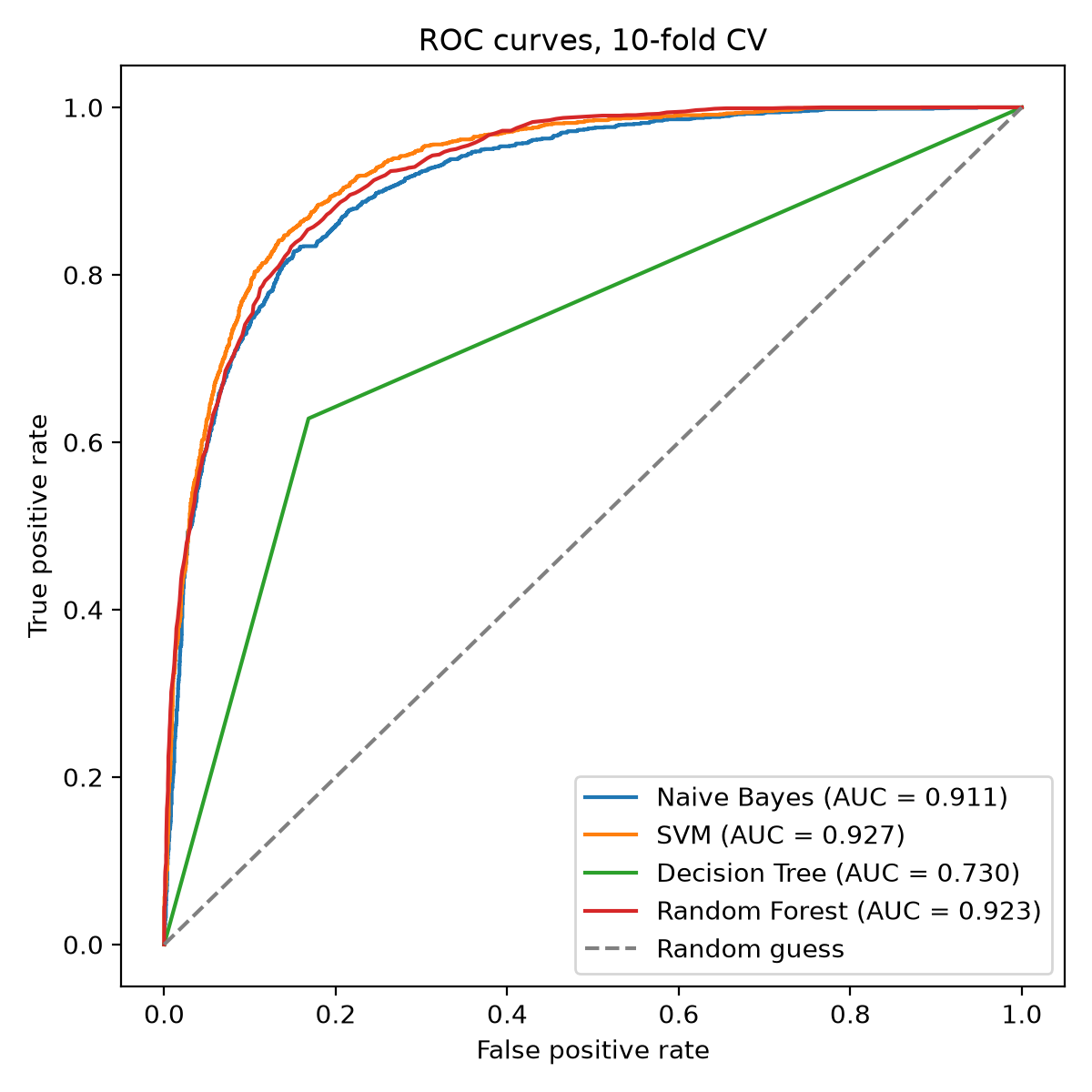
What is it?This is a replication study from CSC 3400. I took a 2017 paper by Poché et al. and reran its classification experiment. The paper asks whether you can automatically find the useful comments on YouTube coding tutorials, like questions and error reports, in the middle of all the praise and spam. I used their 6,000 hand-labeled comments, trained four classifiers on them, and wrote the results up as a paper.
Why did I choose it?It's the most complete thing I have. There's a question, a method, results, and a section on what I couldn't conclude. It was also the first time I checked a published result myself and didn't just take the paper's word for it.
What does it demonstrate?It shows I can evaluate a model without fooling myself. I fit the text features inside each cross-validation fold so the test data never leaks into training. My linear SVM got an F1 score of 0.774 and the paper reported 0.77, and that's with a different toolkit and a different kernel. I also read the data and the paper closely enough to catch a few problems. The dataset had 13 blank lines and some misspelled file names, and the abstract reports 77% accuracy when the results table lists that same number as an F-measure.
What would I do differently?I gave explanations for my results that I never tested. I said Random Forest was probably behind the SVM because of its decision threshold, and that TF-IDF weighting was probably why my Naive Bayes precision came out higher than the paper's. Then I left both as guesses. Either one would have taken a few lines of code to check. I also only ran one random seed and didn't do a significance test, so my ranking of the classifiers is shakier than the tables make it look.
Part 3 .
Closing Reflection
When I look at these four together, what I see is someone who checks things. Only one of them is ambitious. The other three are a replication of somebody else's result, a spreadsheet import that doesn't lose rows, and a filter that sorts English from everything else. In every one of them, the part I cared about was whether something was actually true. Did the result hold up? Did a person write this? Did the upload really work? Can this agent run a shell command or not?
I didn't set out to be that person, mostly because I didn't set out to be a computer scientist. I came in as a biology major and biology was easier. It's term heavy, and I can hold a lot of terms in my head. CS asked for logic and application, and for a while I took how hard it felt as a sign I'd picked the wrong major. I don't think that anymore. The hard part ended up being the part I got the most out of. Freshman me wouldn't have guessed I'd care this much about securing and auditing software that AI helps write, but looking back it makes sense. I like having evidence for things.
What's missing bothers me more than what's here. My two favorite courses were Discrete Mathematics and Computer Organization, and there's nothing from either one in this portfolio. There isn't a single proof, and nothing close to the hardware. That work was all problem sets and exams. I never thought of it as something to keep, and what I still have isn't in good enough shape to show anyone. Operating Systems is the same story. I spent a long time on a synchronization program with a liveness bug, where everything looks correct and one thread still never gets a turn. That was some of the hardest thinking I've done at Belmont and I have nothing to show for it. To fix that I'd have to go back and redo a proof or rebuild that program, and write it up properly this time. I think I should.
Putting this together also made me be honest about something. My biggest project was mostly written by an AI coding agent while I made the decisions. I'm going to be working with these tools for my whole career, so I need to stay clear about the difference between what I built and what I only directed. The other thing I noticed is how recent everything is. All four artifacts are from this past summer and fall. It took me a long time to start making things I'd actually want to put my name on.
The first-year seminar asked who I want to become through this education. Right now my answer is that I want to be someone people can trust to tell them whether a system is doing what it's supposed to do. I'm not there yet. I do have a much better idea of what that work involves than I did when I got here.